Somewhere between not finding fresh chillies and working out where the breakfast cereals have have migrated to during the refurbishment at the local supermarket, there was a gap in the musak. Well not so much a gap, as a break between the soft-focus FM radio pitch-corrected rubbish that seeped from the speakers in the fettuccine ceiling panels. As if the clouds of modern R&B fluff pollution had parted for a moment and let through a ray of truth and light. And into this break came one song that made me stop. And listen. It’s a song I used to know well, but haven’t listened to for a long time now. I had forgotten how good it was.
So I searched it out on You Tube, and was surprised by the clip that came with it. I found the top-hat, monocle and cape kind of weird; and the gesticulating even weirder. Gene Chandler looks uncomfortable in the get-up, and disconnected from his own movements. It’s a stage-show for a negro, for white guys and house-wives, designed by a committee of white guys in ties. But the song is still great 50 years after Chandler recorded it. How many of today’s radio hits will still be played in the fresh produce department half a century from now? Will there be fresh produce? What is the secret of Soylent Green?
For those who have never been to Astra Stube in Hamburg, the venue is about the size of an airing cupboard and nestles resentfully under a railway bridge in Hamburg. I suppose you could say it’s the troll of all venues.
Local four-piece Kapelle Herrenweide kicked off the evening’s entertainment with their brand of urban folk-rock, for want of a better way to describe it. They combine influences from Finnish humppa music, klezmer, and polka, coupled with German pop and schlager, with lyrics which the band and two or three people in the audience (at this point of the evening I wouldn’t call it a crowd) found hilariously funny.
These youngsters lean heavily on German witticisms and social observations from the Teutonic perspective. The lyrics are of course in German. Their music occasionally runs uncomfortably close to bad cabaret with slight rock influences, a style which is well-liked in Germany but I’m not sure if it could really appeal to non-German punters. I couldn’t understand most of their puns and witty innuendo, so concentrated on the musical side of the performance. After three songs I was on the footpath with the rest of the crowd waiting for the Barons of Tang.
If you thought it was hot inside Astra Stube, the thermostat in the broomcupboard was about to be wound open several notches.
Between festivals, Melbourne’s self-proclaimed Pioneers of Gypsy Deathcore decided to grace Hamburg with their presence. And the Barons were worth the wait.
Combining tango, ska, punk, Balkan and metal influences, just to name a few, this seven piece combo from the Antipodes set the place on fire. Packed like cigarettes the crowd moved shoulder to shoulder as a unit, with just enough space down the front for one white guy with dreadlocks (why is there always one?) to embarass himself and everyone else by dancing like no-one was watching.
The lead singer slapped his double bass to psychobilly speed, with a box full of pedals to stomp on, while the rest of the band kept pace on whatever came to hand. It seemed like every member played at least two instruments, often simultaneously.
From « Villain Stage Left », which combines tango strains with old style ska and wistful jazz refrains, to the sheer musical violence of « Dogs of Rotterdam » and « Even if You’re Missing Fingers You Can Still Make a Fist » the Barons of Tang had us totally under their spell until finally the door opened after the last number and the steam rushed out of the pressure cooker. The band and crowd mingled sweatily on the footpath, gasping like fish and gulping beer.
The Barons formed in 2007 and they’ve risen rapidly. This year they played about 40 dates on a merciless three month tour of North America and Europe. That tour sees them with a berth at no less than ten European festivals, including giants such as Roskilde in Denmark, Sziget in the land of the Magyars and Womad in the UK. Not bad for a band that’s only been around a couple of years.
Well, what do you expect when the band is billed as a 19 piece punk brass-band ? What you get is the What Cheer ? Brigade, a street band from Providence, the capital of Rhode Island in the USA. And indeed, the band takes their name from the motto of this state, « What Cheer ? » What Cheer ? Indeed. Rhode Island has eight universities and colleges, a poverty rate of over 20 percent, and is famous for its poultry, but not much else usually happens there.
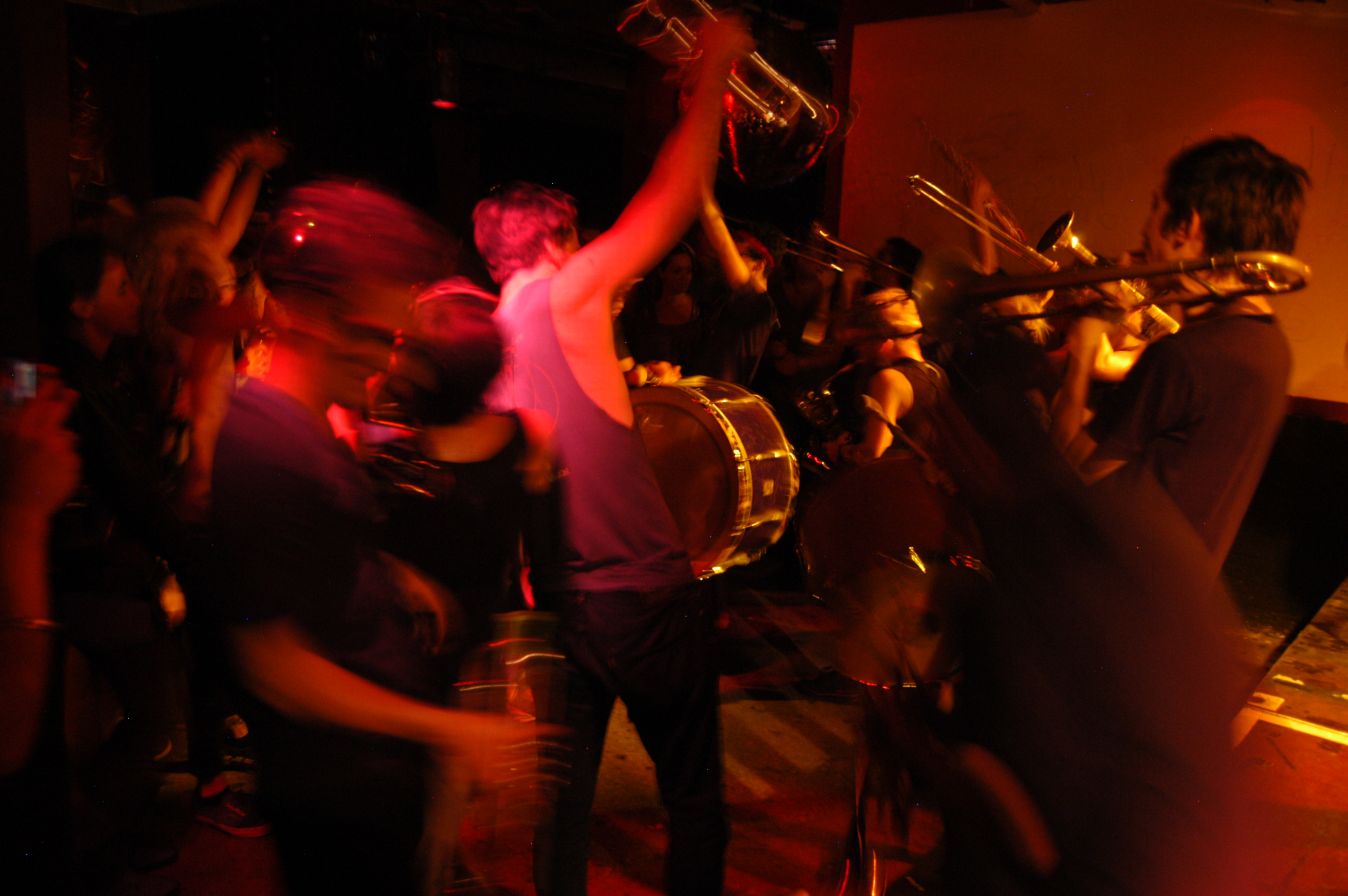
On this particular evening, the sons and daughters of Providence brought their own brand of brass-band chaos to Hafenklang in Hamburg. They almost outnumbered the punters, and it was clear the stage had never been intended to hold a 19 piece brass band. It was also clear that this band was never designed to play on a stage. The group was in constant movement (no surprise, as they’re pretty much a marching band) and the room very quickly became a melee of thrashing trombones and gyrating Germans.
Most Germans love a good marching band, but some punters stood folded-armed and bemused against the walls, short fat bottles of Astra clutched to their breasts. Others appeared to believe themselves accessories to a voodoo rite and, possessed by the spirit of the cornucopia of horns, they whirled and stomped and leaped and sweated with even less rhythm and coherency than the band. It was hard to tell if the enthusiasm was real. or forced – of the kind seen so often at German Samba festivals or at Karneval time in the Rhineland. There was also a disturbingly strong Glee-club vibe coming from the band, which made me wonder if they were Evangelists.
This Brigade really belongs outdoors, in the street, and that’s where they went for their last two numbers. By the time they played the Serbian folk-song Bubamara (The lady bug) I was almost able to enjoy the performance, and the windows of nearby office buildings soon began to fill with people who had fallen asleep at their desks earlier in the evening and were now wondering just who was making all that racket.
I couldn’t help thinking that had the band played in the streets somewhere as part of a larger festival, and I had been drinking rum, they may have been a lot more entertaining.

 ZASPH!